A tight print budget can make a project feel like an exercise in compromise. You know what you want the finished piece to accomplish, but you also have a firm number you cannot exceed. The challenge is figuring out how to bring the two together.
That’s where an experienced print partner makes a difference. Instead of simply taking your specifications, calculating a price and sending back a quote, a knowledgeable team looks at the entire project to find a production path that supports your goals and your budget.
Consider a customer preparing a new publication. The design is taking shape, the quantity is set and there is a deadline for getting copies into readers’ hands. Then, the first budget numbers come into focus, and there’s a problem: There is not enough room in the budget to produce and distribute the project exactly as originally imagined. What happens next?
It Starts With a Conversation, Not a Calculator
The Sales Representative is one of the customer’s primary points of contact throughout a print project. Rather than viewing the project as a fixed set of specifications, the Sales Representative starts by learning what the customer needs the finished piece to accomplish.
For our hypothetical customer, that means the conversation should go beyond, “How much will this cost?” The sales rep needs to understand the intent behind the specifications. Which elements are essential to the finished product? What is the required quantity? When does it need to arrive? How will it be distributed? Most importantly, what budget does the customer need to hit?
Those answers give the print team something more useful than a list of specifications. They provide context. With that context established, the project can move beyond the sales conversation and into a much more collaborative process.
Pre-Press Sets the Project Up for Success
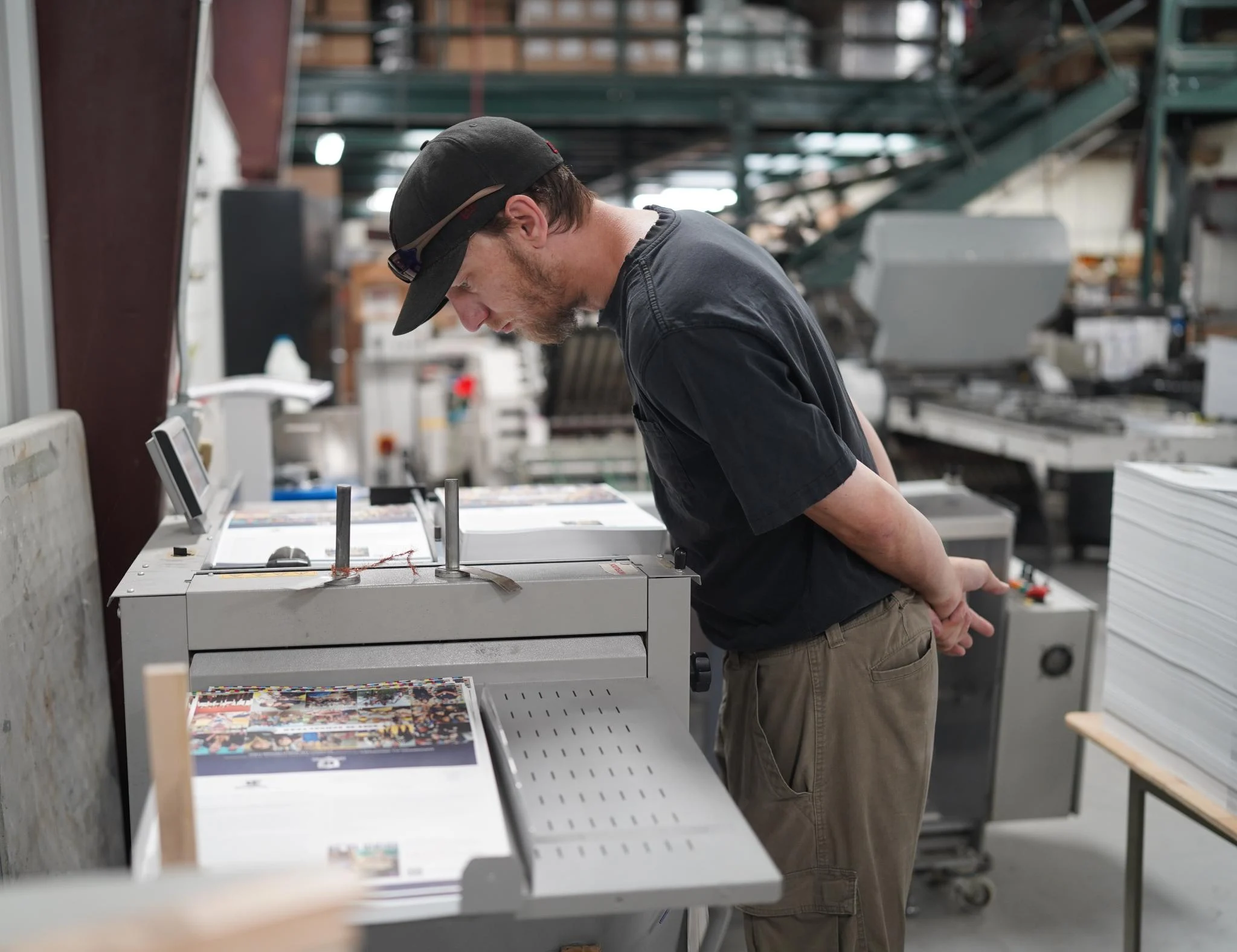
Before a project can be produced efficiently, its files must be ready for production. Pre-press connects the customer’s concept with the physical realities of printing. Files can be reviewed for issues like color mismatches or font conflicts before those issues become production problems.
For a budget-conscious project, that expertise matters. Catching potential complications early gives the team an opportunity to address them while there is still flexibility.
The decisions made at this stage can have implications for production later, so communication between teams helps keep the project moving in the right direction. For the customer, the important point is simple: Their quote is being shaped by people who understand what it will take to turn their vision into a finished piece.
Production Finds the Right Path for the Job
Next comes one of the biggest questions: How should the project actually be produced?
That decision is not one-size-fits-all. Quantity, schedule, expectations and budget all influence the appropriate production method.
Our hypothetical customer may have arrived with one production method in mind. After reviewing the entire project, however, the production team may see another path worth considering. That is precisely why collaboration matters. Instead of viewing production solely as the stage that begins after a quote is approved, an expert print partner can bring production knowledge into planning. The team can consider how the specifications work together and where different decisions could change the economics of the job.
The objective is not simply to find the cheapest way to put ink on paper, but rather to find a production plan that makes sense for what the customer is trying to accomplish.
Bindery Makes Sure the Details Work Together
Printing is only one piece of a finished publication. Once the project comes off the press, it still needs work to become the product the customer envisioned.
Binding and finishing choices influence both the appearance of a printed piece and its cost. Different binding approaches come with different production considerations, making bindery expertise valuable before the final quote, not just after printing.
Suppose our customer’s preferred binding creates an issue with the project’s other specifications or pushes the total beyond budget. A collaborative team can examine the requirements together rather than treating binding as an isolated line item. The customer can then make a deliberate choice, now understanding not only the price but what a change would mean for the finished product.
Mailing and Fulfillment Put the Quote in Context
Packaging, shipping and distribution all contribute to the total cost of getting a printed product where it needs to go. Mailing and fulfillment decisions can also affect costs, schedules and the overall performance of a print program. So, if our customer’s project ultimately needs to reach thousands of individual recipients, a production quote alone does not tell the whole story.
Mailing and fulfillment expertise allows the team to consider downstream requirements as part of the broader plan. That helps the customer evaluate the project based on the real objective: getting the finished piece into the right hands while staying within the available budget.
Considering those requirements before the quote is finalized also helps connect decisions made earlier in the process with what happens after the finished pieces leave production. It turns mailing and fulfillment into part of the plan rather than an afterthought.
Estimating Brings the Pieces Together
By now, the project has benefited from input across multiple departments. Sales understands the customer’s priorities. Pre-press understands the supplied files. Production understands how the piece can be manufactured. Bindery understands what is needed to turn it into the finished product. Mailing and fulfillment understand what happens when production ends. Estimating brings those inputs together into a quote.
This is where a price becomes more than a number. The estimate represents a series of decisions involving materials, production, finishing, labor and distribution. Rather than a list of services with prices, estimating gives the team a clearer view of how those decisions contribute to the overall project.
If the resulting total is still outside the customer’s budget, the team’s work is not necessarily finished. Because each part of the project has been considered together, the conversation can focus on informed tradeoffs instead of arbitrary cuts.
A Better Quote Starts With the Print Partner
Working within a tight printing budget does not have to mean stripping away everything that makes your project effective. It starts with giving experienced people the opportunity to understand what matters to make informed recommendations.
At Walsworth, we bring expertise from across the print journey together to help customers find the right solution for each project. Whether you are planning a book, magazine, catalog or another print project, we want to know what you need to accomplish and what budget you need to work within. Contact Walsworth to discuss your next project and request a quote.
* This article was developed with assistance from OpenAI’s GPT 5.5 large language AI model.